Select the XTOOL website you want to visit.
You will only be redirected after selecting a website.
The correct choice between static and dynamic ADAS calibration starts with the vehicle manufacturer's procedure for the specific vehicle and sensor. Workshop space, weather and equipment availability affect whether you can complete that procedure; they do not determine which method the vehicle requires.
For workshop managers, this distinction matters before quoting a job or buying equipment. A calibration system should match the procedures your target vehicles require, with a realistic plan for preparation, execution and documentation.
Static ADAS calibration is a stationary procedure that establishes a sensor's reference using the setup, targets or fixtures specified by the vehicle manufacturer.
The vehicle does not move during the calibration itself. Depending on the system, the procedure may involve a camera target, radar reflector or other prescribed reference. Target location, height, orientation, vehicle centerline and the condition of the working area can all affect the setup.
I-CAR's explanation of calibration distinguishes stationary static calibration from on-road dynamic calibration and explains that clearing codes is not calibration. A workshop should therefore identify the actual aiming procedure rather than relying on a menu label such as “reset.”
Prepare a job-specific setup sheet from the OEM information. Record required tire pressures, vehicle loading, ride-height or alignment prerequisites when specified, and the applicable target geometry. Do not substitute a generic floor tolerance or target distance for the vehicle's requirements.
For a simple geometric illustration, an angular difference of 0.1 degrees over 3 meters corresponds to about 5.2 millimeters of lateral displacement: 3,000 × tan(0.1°). This is not an OEM tolerance or an equipment specification; it shows why measuring both orientation and position matters.
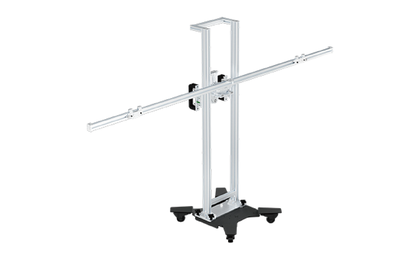
The XTOOL ACT600 ADAS calibration system is a portable, movable platform with laser positioning and adjustable target setup. Confirm the exact targets, fixtures and compatible diagnostic platform required for your intended applications. Plan preparation, calibration and final verification around the OEM procedure rather than assuming one setup time applies to every job.
Dynamic ADAS calibration is a procedure in which a supported system learns or verifies its reference while the vehicle is driven under OEM-defined conditions.
The conditions may specify road markings, speed, visibility, weather, traffic and diagnostic-tool operation. A general road test is not automatically a dynamic calibration. The technician must establish that the required calibration routine was initiated and reached the completion state described by the manufacturer.
Do not publish one driving speed or duration as suitable for every vehicle. A procedure that succeeds on a particular camera system may be inappropriate for another sensor or model year. Equally, the absence of a target board does not eliminate preparation, scan-tool or documentation requirements.
Plan the route and staffing before accepting the job. Where the routine requires tool interaction during driving, arrange the work so that the driver remains focused on the road and follows the manufacturer's instructions. If weather or road conditions prevent the required procedure, document the reason for postponement rather than substituting another method.
An ADAS calibration decision matrix translates the exact vehicle-and-sensor procedure into the resources and completion evidence needed for the job.
Start with the VIN, model year, market, installed system and repair event. A windshield camera, forward radar and surround-view camera on the same vehicle can have different requirements. Research each affected system separately.
The I-CAR OEM Calibration Requirements Search is a useful research starting point, but I-CAR states that its database does not cover every production vehicle and directs repairers to current vehicle-maker information. Retain the applicable OEM procedure and its revision with the job.
| Decision factor | Static procedure | Dynamic procedure | Combined requirement |
|---|---|---|---|
| Vehicle movement | Stationary during calibration | Driven under prescribed conditions | Both stages as specified |
| Primary resources | Suitable bay, specified targets or fixtures and required diagnostic tool | Suitable route, required diagnostic tool and qualifying road conditions | Both sets of resources |
| Common scheduling constraint | Bay geometry, setup conditions or missing target | Weather, visibility, road markings or traffic | Ability to complete the required sequence |
| Completion evidence | Recorded setup and routine result | Recorded conditions and routine result | Evidence for every required stage |
| Who selects the method? | The current OEM procedure for the specific vehicle, sensor and repair event | ||
Do not use a clean scan as the sole reason to skip calibration. American Honda's March 2024 post-collision diagnostic guidance explains that certain driver-assistance systems may require aiming after relevant component work even when a scan does not show a DTC. Confirm applicability to the actual repair rather than extending the statement to every system.
Compare ADAS calibration equipment against the completed matrix. This makes procurement a question of supported procedures and complete configurations rather than a comparison of frame dimensions alone.
ADAS workshop planning is the process of matching confirmed service demand with the equipment, working conditions and records required to complete it.
Build an application sheet for the vehicles you actually service. For each entry, record the sensor, calibration trigger, required method, target reference, diagnostic platform and any access requirements. Identify which accessories are included in a quotation and which must be added.
Then check the available bay and routes against those applications. Allow for vehicle positioning, target placement, access around the equipment and any environmental restrictions in the procedure. A folding frame may help storage, but storage size does not define the space needed to perform a calibration.
The job record should retain the pre-scan, relevant repairs, setup measurements, target identifiers, diagnostic-software version, calibration result and required post-checks. If the procedure fails, record the exact stage and message; do not reduce an incomplete job to “ADAS warning still on.”
Review XTOOL vehicle function coverage and request confirmation for your target model years and systems. Provide your vehicle mix, intended services, existing scanner and bay measurements when discussing an ASCT-1000 configuration. Ask for an application-specific demonstration and an itemized accessory proposal.
The correct ADAS calibration method is the one required for the specific vehicle, sensor and repair event.
Confirm that procedure first, then plan the bay, route, equipment and evidence around it. This gives workshop managers a clearer basis for quotations and helps technicians document that the required work was completed.
These ADAS calibration questions clarify how method selection affects workshop equipment and verification.
The vehicle manufacturer's current procedure defines the required method for the specific application and repair event.
Yes. Follow every required stage and its specified sequence rather than choosing only the more convenient method.
No. The procedure may still require diagnostic equipment, preparation and specific operating conditions.
They affect whether the vehicle and calibration references can be positioned as the OEM requires.
Do not assume universal coverage. Confirm the target and fixture requirements for each intended application.
Retain the OEM reference, setup or driving conditions, equipment identifiers, routine result and required post-check evidence.