Select the XTOOL website you want to visit.
You will only be redirected after selecting a website.
Leading EV battery manufacturers include CATL, BYD's battery business, LG Energy Solution, Panasonic, Samsung SDI and SK On, alongside Chinese suppliers such as CALB, Gotion, EVE Energy, SVOLT and Sunwoda. Their products power vehicles from many automakers. For a repair workshop, identifying the supplier is useful background; identifying the battery pack installed in the vehicle is the starting point for diagnosis.
A vehicle badge does not reveal every battery configuration. Suppliers, chemistry, capacity and pack design can vary by model year, production location and trim. This guide connects the global supplier map with the questions technicians should ask before choosing a diagnostic or battery service procedure.
Key takeaways
- China is central to global EV battery manufacturing, while Korean and Japanese suppliers remain important across international vehicle platforms.
- An automaker's supply agreement does not establish the battery fitted to every vehicle carrying its badge.
- Battery chemistry, pack structure and BMS software affect how diagnostic data should be interpreted.
- Professional service requires separate decisions about diagnosis, repair suitability and post-repair verification.
Evidence reviewed on October 13, 2026. This is a sourced industry guide published by XTOOL, a diagnostic and service equipment manufacturer. It is not a vehicle teardown report or a substitute for model-specific OEM service information.
Chinese battery manufacturers supply both Chinese automakers and international vehicle programs. A workshop servicing European, American or Asian brands can therefore encounter Chinese-made cells or packs without servicing a Chinese-branded vehicle.
SNE Research's October 2, 2026 release reported 844.2 GWh of battery usage in electric vehicles registered worldwide from January through August 2026, up 19.7% year over year. CATL held 39.4% of that market, BYD 15.1%, and LG Energy Solution 8.1%. The seven Chinese suppliers in the top ten together accounted for 73.3%.
These figures measure installed battery usage in SNE's EV, plug-in hybrid and hybrid categories. They are not battery production capacity, shipments or a pure-BEV-only ranking. They also do not measure failure rates.
The IEA's Global EV Outlook 2026 reports that China accounted for more than 80% of global EV battery cell production in 2025. The practical implication is a diverse service environment: workshops need to understand Chinese supply chains while retaining the knowledge to work with established Korean and Japanese systems.
An EV battery supplier can provide cells, modules or a complete pack. The automaker or another integrator may design the enclosure, cooling system and controls around those cells. The battery management system, or BMS, monitors the battery and manages operation within programmed limits.
Three names on a workshop record may therefore describe different responsibilities:
- Cell manufacturer: produces the electrochemical cells.
- Pack manufacturer or integrator: combines cells with cooling, connections, protection and an enclosure.
- Vehicle manufacturer: integrates the pack with the vehicle's high-voltage system and service requirements.
Product names add another layer. BYD's Blade Battery uses lithium iron phosphate (LFP) chemistry, according to BYD's technology description. CATL's technology portfolio describes Qilin products across different chemistries. A familiar product name is not a complete specification.
Record the actual pack part number, serial number, chemistry, capacity and software identity wherever available. Use the vehicle identification number, or VIN, to obtain the relevant service information, and check whether the pack has been replaced. For a vehicle that can exchange batteries, verify the pack currently fitted.
The following table is a supplier orientation guide, not a diagnostic tool coverage list. It highlights publicly documented products and relationships rather than ranking reliability.
| Manufacturer | Publicly documented focus or example | What the workshop should verify |
| CATL | Broad battery portfolio; Qilin pack integration and Shenxing LFP products. [Technology source]. | Exact chemistry, pack generation, cooling layout and BMS interface |
| BYD / FinDreams Battery | Blade Battery technology based on LFP. FinDreams is a BYD subsidiary, identified in [BorgWarner's 2024 agreement]. | Blade generation, pack part number and vehicle integration |
| CALB | LFP and ternary battery applications for passenger vehicles. [Passenger vehicle portfolio]. | Cell specification, monitoring system and approved repair level |
| Gotion High-Tech | Named alongside CATL in BMW's sixth-generation cylindrical cell supply program. [BMW disclosure]. | Cell format, vehicle generation and service instructions |
| SVOLT | NCM and LFP Short Blade products for passenger vehicles. [Passenger vehicle portfolio]. | Chemistry and electrical limits; a Short Blade name alone does not identify the complete pack |
| Sunwoda | EV battery technology, including fast-charging products. [Technology source]. | Vehicle-specific pack, interface and repair documentation |
| AESC | Founded in Japan, with a global manufacturing footprint; Nissan LEAF is a documented customer application. [Company source]. | Production source and pack generation rather than assumptions based on company nationality |
AESC also illustrates why a simple nationality label can be misleading. [Envision disclosed its acquisition of Nissan's battery business in 2018], while AESC retains Japanese origins and manufacturing operations across several regions.
Outside this group, LG Energy Solution, Samsung SDI, SK On and Panasonic remain important suppliers. Their relevance follows specific vehicle programs: LG's joint venture with GM, Samsung's BMW supply contract, SK On's Hyundai and Kia applications, and Panasonic's Tesla relationship are documented in the examples below.
Automakers commonly use more than one supplier. Public announcements establish a relationship or a particular vehicle program; the fitted pack must still be checked on the vehicle.
| Automaker or brand | Documented supplier example and evidence date | Scope of the evidence |
| Tesla | Panasonic and CATL in the [2024 annual report]; LG Energy Solution also identified as a supplier in [IEA's 2026 battery analysis]. | Corporate supply relationships; not a VIN-level Model 3 or Model Y lookup |
| BYD | Blade Battery in its current [official technology overview], reviewed October 2026 | Establishes the technology and chemistry; capacity and generation still vary |
| NIO | Listed among CATL's automaker customers in its [May 2025 prospectus] | Customer relationship; does not assign all NIO capacities to one supplier |
| Li Auto | [CATL cooperation announcement, September 2025] | Existing supply and future cooperation across several chemistries; not proof that every announced chemistry is fitted today |
| ZEEKR | [CATL Qilin cooperation, August 2022]; [1,000-km ZEEKR 001 delivery, June 2023] | Specific Qilin vehicle programs, not the full ZEEKR range |
| XPeng | CALB's [September 16, 2025 IAA report] names its fast-charging battery application in the new P7 | A defined model program; other models and years require separate checks |
| BMW | CATL and Samsung SDI for fifth-generation systems in [November 2019 procurement disclosure]; CATL and EVE in [September 2022 sixth-generation plans] | Different generations and formats; historical contracts are not a current fitted-parts catalogue |
| Mercedes-Benz | [CATL supplier cooperation, August 2020] | A major supplier relationship, not exclusive supply to every Mercedes EV |
| Volkswagen Group | LG, Samsung, SK Innovation and CATL in its [2018 supplier announcement]; Gotion in the [2026 partnership announcement] | A changing multi-supplier network; region and platform determine relevance |
| Hyundai / Kia / Genesis | SK On applications in IONIQ 5, EV6 and GV60 named in the [April 2023 Hyundai announcement] | Documented applications, not exclusive group-wide supply |
| GM / Cadillac / Chevrolet | LG Energy Solution through Ultium Cells; LYRIQ and several Chevrolet EVs named in [GM's December 2024 announcement] | Named North American programs; other markets and future designs need separate verification |
| Ford | Listed among CATL's automaker customers in its [May 2025 prospectus] | Customer relationship as of the disclosure period; no model, trim or chemistry assignment is made here |
| Nissan | LEAF named as an AESC-powered vehicle in [AESC's company article], reviewed October 2026 | A representative historic application, not a statement about every Nissan EV or latest LEAF generation |
This table helps technicians know where to look. It cannot select a replacement module, determine warranty eligibility or prove that a scan tool supports a battery's communication protocol.
Battery chemistry and construction change the meaning of a reading and the practical scope of a repair. Nickel manganese cobalt chemistry is abbreviated NMC or NCM; cell-to-pack integration is abbreviated CTP. The original equipment manufacturer (OEM) supplies the vehicle-specific service requirements. Read the data in context before deciding that a cell, module or complete pack has failed.
| Battery characteristic | Diagnostic implication | Information to confirm |
| LFP chemistry | Its flat voltage profile makes voltage-only state-of-charge estimation difficult. Similar resting voltages do not establish equal capacity. | Temperature, SOC, measurement conditions, dynamic behavior and the OEM's assessment method |
| Nickel-containing chemistry, including NMC/NCM | Use the exact cell and pack limits; LFP assumptions cannot be transferred to another chemistry. | Specified operating limits, thermal conditions and the relevant BMS calibration |
| Mixed-chemistry or newer battery systems | A conventional single-chemistry interpretation may be incomplete. | Actual architecture and the manufacturer's diagnostic documentation |
| CTP or structural integration | Removing a module level or integrating the battery with the body changes access and repair options. | Approved repair level, fixtures, joining methods and post-repair verification |
[Texas Instruments explains the SOC-estimation challenge created by LFP's flat voltage profile]. BMW's sixth-generation technical disclosure gives a separate example of construction change: its described architecture eliminates the cell module level and gives the battery system a role in the body structure. These are reasons to consult pack-specific information, rather than universal voltage thresholds or teardown assumptions.
SOC means state of charge: how much charge is currently available. SOH means state of health: an estimate of battery condition relative to a reference. A BMS-reported SOH value belongs to that manufacturer's estimation system. Record its definition and conditions before treating it as equivalent to an independently measured capacity result.
Balancing addresses differences in charge state where an approved service procedure calls for it. It does not reverse cell aging. For a focused explanation, see [EV battery balancing and its limits].
Start by deciding whether the vehicle belongs in a routine diagnostic workflow or a damaged-battery response process. Collision, flooding, enclosure damage, leakage or abnormal heating changes the job.
The [NHTSA electric vehicle safety guidance] warns that physical damage can cause immediate or delayed release of toxic or flammable gases and fire. A quiet battery or an absence of current fault codes does not establish that a damaged pack is safe to charge or test.
For ordinary service work, use this decision sequence:
1. Identify the fitted system. Record VIN, model year, pack identity, repair history and relevant recalls or service actions.
2. Preserve the evidence. Save diagnostic trouble codes, freeze-frame records, software versions and available live data before clearing faults.
3. Localize the fault. Follow the OEM fault tree across the high-voltage system. A charging problem or an isolation fault does not, by itself, prove an internal battery defect.
4. Interpret readings under defined conditions. Record SOC, temperature, load and test method when comparing cells or assessing performance.
5. Establish the permitted repair level. Confirm approved parts, procedures, equipment and access to the required software functions before opening a pack.
6. Plan verification before starting the repair. Specify the electrical, cooling, sealing and functional checks required for release.
High-voltage work requires trained personnel, appropriate protection and verified isolation according to the vehicle's procedure. Disconnecting the low-voltage supply or opening vehicle contactors does not remove the energy stored in the pack's cells. [HSE's repair guidance] sets out the need for vehicle-specific information, specialist equipment and safe isolation practices.
Cooling and sealing deserve separate attention. Use the specified coolant and approved leak-test method. Tesla's [battery underside-damage technical note], for example, says not to pressurize the cooling system when a battery coolant leak has been determined. That instruction illustrates why a generic pressure setting is inappropriate across battery designs.
Replacement cells or modules must meet the manufacturer's approved compatibility and matching requirements. Similar appearance, nominal capacity or resting voltage alone is insufficient. Keep safety interlocks and protection functions intact; a successful fault-code clear is not a repair acceptance test.
Build the equipment specification around the vehicle and the work required. A useful request names the model year, pack identifier, connection method and required diagnostic or service function.
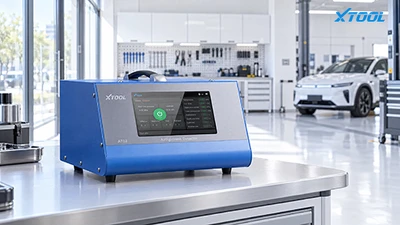
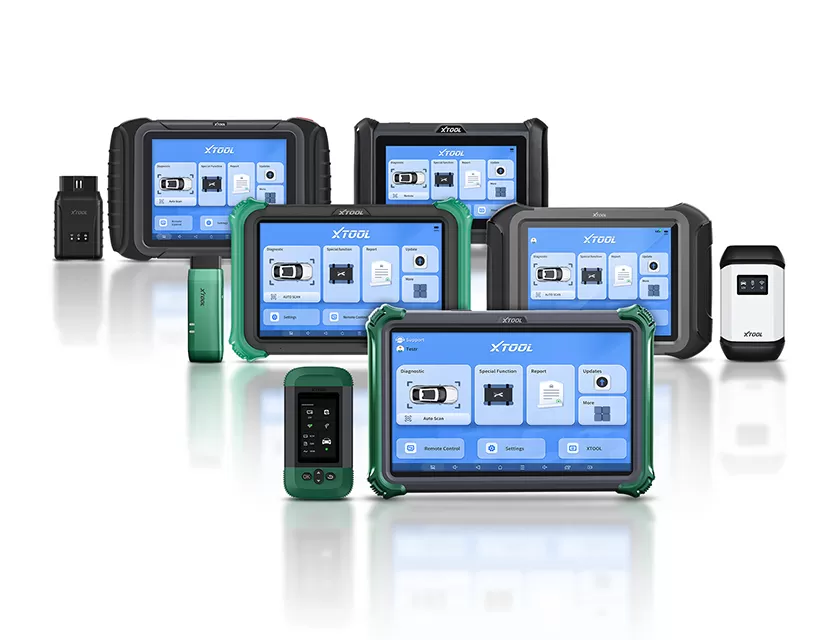
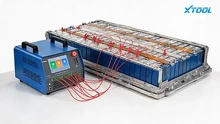
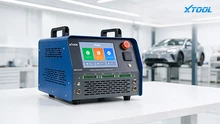
Within XTOOL's product range, [E2 Pro] provides a professional EV diagnostic platform with CAN FD and DoIP support. [BEC2440] addresses charging, discharging and balancing tasks, while [AT02] addresses air-tightness and leak testing. These are different jobs and require their own compatible setup and acceptance criteria.
Vehicle coverage, available functions, adapters, operating conditions and regional configurations must be confirmed against current documentation. Supporting a vehicle brand does not establish support for every battery from its cell supplier. See the [current function lists] and [EV diagnostic tool range] when assessing fit.
Tesla sources batteries from established suppliers including Panasonic, CATL and LG Energy Solution, as described in the sources above, and also develops its own cells. The supplier fitted to a particular vehicle depends on the production program and must be verified from its actual configuration.
Yes. CATL and CALB, for example, document products across LFP and nickel-containing chemistries. Use the installed pack specification to choose the correct diagnostic criteria.
A low reported SOH is one piece of evidence. Confirm what the value represents, the customer's symptoms, available capacity evidence and the OEM diagnostic result before deciding on repair or replacement.
Balancing can address charge-state differences when the system is suitable for the prescribed procedure. It does not restore the original capacity of aged or damaged cells.
No. Coverage depends on the vehicle, pack communication, software and connection method. Verify the required function for the actual application before purchasing equipment or accepting the job.
Writer: Anastasia ZHANG