Select the XTOOL website you want to visit.
You will only be redirected after selecting a website.
The 2026 Paris Motor Show is under way. New models, driving range, charging speed and world premieres are attracting most of the attention. From an automotive aftermarket perspective, however, another question deserves equal scrutiny: as more Chinese battery electric, plug-in hybrid and range-extended vehicles enter Europe, will local dealers, service networks and independent workshops be ready to support them effectively?
As a vehicle diagnostic equipment brand serving repair professionals worldwide, XTOOL looks beyond which model draws the biggest crowd on the show floor. We also track how quickly new platforms, powertrains and electronic architectures are reaching the workshop. The message from Paris is clear: competition in the European vehicle market is expanding beyond the vehicle itself to include localization, technical training and service capability throughout the ownership lifecycle.
Key takeaways
- The growing presence of Chinese brands in Paris comes from a broad mix of brands, powertrains and price points—not a single headline model.
- EU countervailing duties remain in force for Chinese-made battery electric passenger vehicles within the scope of the measures, but competition continues through pricing, other powertrain types and local investment.
- Chery’s service network development, ACC’s battery cell output in France and manufacturers’ restructuring of model families all show that after-sales capability has become part of market entry.
- Independent repairers need to prepare for more vehicle platforms, communication protocols, battery systems and software functions arriving in their workshops at the same time.
| Signal from the show | Impact on Europe’s aftermarket | What workshops need to prepare |
| Chinese brands span more price points and powertrain types | A wider mix of brands, platforms and components will enter the workshop | Accurate vehicle identification, coverage lookup and multi-brand diagnostics |
| BEVs, PHEVs and HEVs will coexist for years | Fault chains will cross combustion engines, electric motors, batteries and thermal management | Full-system scans and powertrain-specific diagnostic processes |
| Local production, parts and training are advancing together | After-sales capability is becoming a condition of market entry | Technical training, parts processes and post-repair validation |
The [official Paris Motor Show exhibitor list] includes Chinese automotive groups and brands such as BYD, CHERY, Changan, GAC, Geely and Leapmotor alongside French, German and other international manufacturers. Industry observer [Jason Zhao] describes this year’s event as a direct meeting between China’s automotive supply chain and the rules of the European market, raising the question of whether tariffs can stop the expansion of Chinese automakers. The exhibitor totals and market figures in his LinkedIn post are the author’s own calculations and are not treated here as official show data.
More significant than the number of exhibitors is the variety of powertrains they represent. Chinese manufacturers are bringing more than battery electric vehicles. [Chery is showing hybrid TIGGO models and the urban electric CHERY Q]. [BYD’s stand includes both battery electric and plug-in hybrid vehicles], while the company continues to promote its DM-i range in France. In an official LinkedIn post, [BYD France] said it achieved a 22% share of the French PHEV market in May 2026, with 1,745 registrations. Because these figures were published by the brand, they should still be cross-checked against French registration data. Even so, they highlight an important point: European aftermarket demand can no longer be assessed through battery electric vehicle penetration alone.
For repair businesses, the long-term coexistence of battery electric vehicles (BEVs), plug-in hybrid electric vehicles (PHEVs), hybrid electric vehicles (HEVs) and range-extended electric vehicles (REEVs) means that combustion engines, electric motors, high-voltage batteries, charging systems, thermal management and multiple layers of control software will appear in different combinations. More models are only the visible part of the change. The number of system combinations technicians must diagnose is growing rapidly.
In January 2026, the [European Commission reiterated] that countervailing duties of 7.8% to 35.3% had applied since October 2024 to new battery electric passenger vehicles imported from China and falling within the defined scope of the measures. The regulated product scope also covers certain vehicles driven by an electric motor and equipped with an auxiliary internal combustion engine as a range extender. The Commission also issued guidance on price undertakings, under which exporters may propose minimum import prices, sales channels and EU investment commitments for case-by-case assessment.
This shows that the terms of competition in Europe are still evolving. Battery electric vehicles face duties and potential price undertakings, while plug-in hybrids are subject to different product and regulatory conditions. At the same time, local investment, distribution development and service capability are becoming more important.
From an aftermarket perspective, trade policy does not make vehicles already on the road any simpler to service. Whether a vehicle enters Europe through direct import, local assembly or another commercial arrangement, workshops still need to identify the exact vehicle, establish communication, access control units, assess the high-voltage system and verify the repair. Market rules may change the route a vehicle takes into Europe, but they do not reduce the diagnostic work waiting for the workshop.
A familiar model name does not guarantee a familiar technical platform. In a LinkedIn analysis of the Volkswagen ID. Tiguan, automotive product strategist [Wojciech Dziembała] notes that Volkswagen is extending the familiar Tiguan name to an electric vehicle instead of keeping every EV within a separate, number-based ID. family.
The [official Volkswagen announcement] partly supports this reading: the ID. Tiguan is scheduled to launch in early 2027 and will be sold alongside the current Tiguan with petrol, diesel and hybrid powertrains. To customers, these vehicles belong to one easy-to-understand model family. To technicians, they may represent different platforms, communication architectures, software baselines, powertrain components and service procedures.
A similar name is therefore not a safe diagnostic assumption. Independent workshops need to confirm the VIN, model year, powertrain, market version, control units and software level. A common future mistake may be less about failing to recognize the brand and more about underestimating the vehicle architecture because the model name looks familiar.
Localization in Europe’s electrified vehicle market now includes parts supply, technician training, service networks and battery production—not only vehicle assembly. Chery and ACC provide two examples that could easily be overshadowed by the vehicle launches.
The first comes from Chery. [Chery France previously announced] that more than 50 sales and authorized repair sites would be operational when the brand entered France in September 2026, with more than 90 locations planned by year-end. A local parts center in France supports the repair network. [AM Today later reported on LinkedIn] that Chery Groupe France was also working with Valeo Tech Academy to train network technicians in hybrid technology. The latter is a media report, but its direction is consistent with Chery’s published after-sales network plans: entering a new market requires the vehicle, parts, people and service processes to be prepared together.
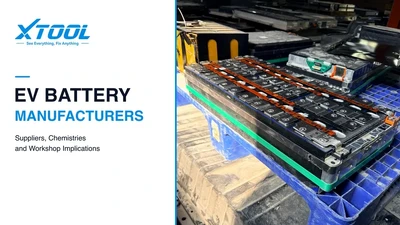
The second development comes from Europe’s battery supply chain. [ACC announced at the Paris Motor Show] that its Billy-Berclau/Douvrin gigafactory in France had produced its five-millionth lithium-ion cell—an output the company equates to nearly 40,000 electric vehicles. This figure represents more than manufacturing progress. As the installed base grows, the associated battery systems will gradually enter inspection, collision repair, condition assessment and recycling workflows throughout the vehicle lifecycle. Our [workshop guide to EV battery manufacturers, chemistries and pack identification] explains why the supplier name alone is not enough to select a diagnostic or service procedure.
The simultaneous expansion of vehicle and battery localization will expose Europe’s aftermarket to more sources, more designs and more service requirements. Repair capability must develop at the same pace as the vehicles entering the market.
The vehicles displayed in Paris will move through several stages: launch, sale, delivery and growth of the installed base, followed by routine maintenance, fault diagnosis, collision repair, battery condition assessment and electronic system calibration. Aftermarket businesses do not need to wait until large numbers of these vehicles are out of warranty before preparing. Pre-delivery inspection, troubleshooting, software-related services and collision repair will arise much sooner.
XTOOL’s editorial conclusion from the cited market evidence is that competition in electrified vehicles has moved beyond driving range. It now involves the complete vehicle, charging, software, parts, training and service networks. For independent workshops and dealers, the practical next step is to establish a diagnostic process capable of handling multiple brands, multiple powertrains and frequent software updates. The broader market context is covered in [Global EV Sales Keep Climbing: Is the Aftermarket Ready?].
Writter: Anastasia ZHANG