Select the XTOOL website you want to visit.
You will only be redirected after selecting a website.
Reading OBD2 live data for a lean code is a way to test competing explanations before recommending parts. A positive fuel-trim value shows that the control system is requesting additional fuel under the observed conditions; it does not identify a failed component by itself.
For technicians investigating P0171 or P0174, the useful question is how the data changes with operating conditions and whether independent tests support the suspected cause. A well-recorded comparison is more persuasive than a screenshot of one unusual number.
Lean-code live-data diagnosis compares fuel-control corrections with engine operating conditions to select and verify the next diagnostic test.
Save the original codes, their status and any available freeze-frame information before changing the vehicle state. Ford's model-year 2024–2025 gasoline OBD operation summary identifies P0171 as system too lean on bank 1 and P0174 as system too lean on bank 2. Its monitor descriptions also show why entry conditions and fuel-control strategy matter; those details must not be generalized to every engine.
Start with short-term fuel trim (STFT), long-term fuel trim (LTFT), loop status, engine speed, coolant temperature and calculated load. Add relevant airflow, manifold pressure, oxygen or air-fuel sensor information, commanded mixture and fuel-pressure data where supported. On engines with two banks, compare corresponding values rather than combining unrelated channels.
Evaluate gasoline diagnostic tools according to the parameters and recording workflow required by the engines you service. A long function list is less useful than a demonstrated ability to capture the relevant conditions clearly.
Snap-on's U.S. Domestic Vehicle Communication Software Manual describes positive percentage fuel trim as added fuel and negative trim as reduced fuel for the parameters documented there. Confirm the actual PID definition and scale: a manufacturer-specific parameter may use counts or a different reference point.
Do not apply narrowband oxygen-sensor voltage rules to a wideband air-fuel sensor. Record the sensor type and parameter meaning before interpreting its output. A measured lambda value, commanded equivalence ratio and conventional oxygen-sensor voltage are not interchangeable labels.
A fuel-trim comparison records the same relevant parameters under controlled, documented conditions so that changes can be interpreted.
First establish whether the engine is operating in the fuel-control state required for the investigation. Warm-up, open-loop operation, acceleration enrichment, deceleration fuel cut and purge operation can change the meaning of a snapshot. Follow the OEM test conditions, and do not maintain a particular engine speed merely because a generic guide suggests it.
The following figures are invented teaching data for one hypothetical bank, not customer results, normal ranges or a test procedure. They demonstrate why a change between conditions can be more useful than a single reading.
| Recorded condition | Engine speed | Loop state | STFT, bank 1 | LTFT, bank 1 | Interpretation to investigate |
|---|---|---|---|---|---|
| Warm, stabilized idle | 750 rpm | Closed loop | +18% | +8% | Additional fueling is being requested at idle |
| Permitted steady higher-speed condition | 2,500 rpm | Closed loop | +4% | +8% | The short-term correction is smaller in this observation |
In this example, the change justifies investigating why correction is greater at idle; it does not prove an intake leak. Record coolant temperature, load, purge state, accessories and other relevant influences alongside the trims. A different adaptive cell or transient condition can complicate the comparison.
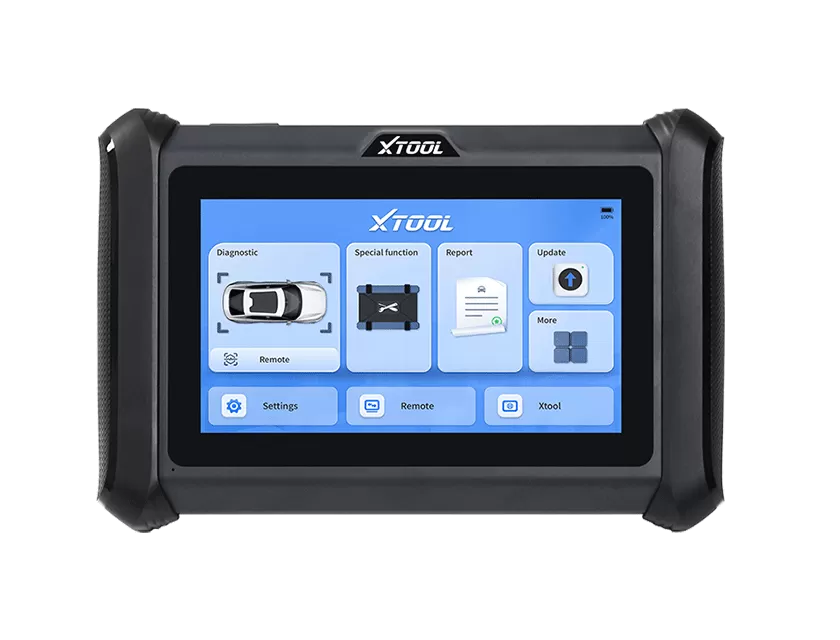
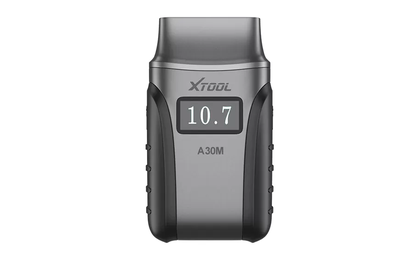
The XTOOL A30M live-data platform is described by XTOOL as supporting graphing, recording and playback of up to 8 data streams together. Confirm the available PIDs and current app behavior on the target vehicle. Select a focused group of parameters and retain the sampling context rather than assuming every displayed value was captured simultaneously.
A diagnostic data pattern is a repeatable relationship that supports a testable hypothesis rather than a direct instruction to replace a part.
Choose the next test by asking which explanation the evidence can distinguish. A correction concentrated at idle may justify checking for unmetered air using the applicable leak-testing procedure. A correction that persists or increases under relevant load may justify checking fuel delivery and airflow plausibility. Neither pattern establishes a cause without corroboration.
| Observed pattern | Possible investigation | Evidence still needed |
|---|---|---|
| Greater positive correction at idle | Unmetered-air or purge-related investigation | Applicable leak, purge and system-integrity checks |
| Positive correction across relevant load conditions | Fuel-delivery and airflow plausibility checks | Specified pressure, delivery or signal tests |
| One bank differs substantially from the other | Bank-specific air, exhaust, injector or sensor investigation | Bank-specific test results and correct sensor interpretation |
| Lean indication with rough running or misfire evidence | Combustion and misfire investigation | Tests that distinguish a fueling problem from oxygen left by incomplete combustion |
Check for contradictory evidence. An oxygen-related code does not automatically condemn the oxygen sensor, and a plausible fuel-pressure reading at idle may not answer a delivery question under load. Use the OEM diagnostic path to determine the measurement conditions and equipment needed.
There is no single fuel-trim percentage that identifies the same failure on every engine. Do not transplant a monitor threshold from another engine, or treat a graph's scale limit as a service specification.
Repair verification is a repeatable comparison showing whether the confirmed fault and its associated symptoms changed after corrective work.
Retain the failed test that justified the repair, the work performed and the matching post-repair test. Compare live data under equivalent temperatures, loop state and operating conditions. If adaptive values were reset under the OEM procedure, disclose that change before comparing them with the original values.
Record remaining codes, pending results and readiness information. The California Bureau of Automotive Repair's readiness-monitor definitions explain that readiness reports whether emission-system self-tests have run. An extinguished warning lamp is therefore not the same evidence as a completed monitor. Use the applicable local inspection requirements if an emissions test is part of the job.
Before choosing equipment, review XTOOL diagnostic function coverage and request a target-vehicle demonstration of the required live data, graphing and recording. Provide the engine, model year, relevant codes and desired PID group so the discussion addresses your workshop's actual diagnostic work.
A defensible lean-code diagnosis connects recorded fuel-control behavior to an independent test and a repeatable repair check.
Use OBD2 live data to narrow the investigation, preserve the conditions behind each reading and verify the confirmed repair. That workflow gives customers a clearer reason for the work recommended and helps workshops avoid decisions based on isolated numbers.
These lean-code questions clarify what fuel-trim data can establish and how it should guide testing.
No. It identifies a monitored condition; air, fuel, exhaust, combustion or sensing problems may require investigation.
A repeatable change can help distinguish hypotheses that a single idle reading cannot separate.
No. Parameter definitions, adaptive strategies and diagnostic limits depend on the application and OEM information.
No. Generic PIDs provide useful evidence, while the applicable procedure defines how to test the suspected fault.
Retain PID labels and units, bank identification, timestamps, loop state, temperature, speed, load and relevant test conditions.
Repeat the fault-confirming test, compare equivalent operating conditions and document code and monitor status.